

2026 Best Ceramic Ball Filler Suppliers for Global Buyers?

Choosing a reliable Ceramic Ball Filler supplier in 2026 requires more than comparing catalog prices. Global buyers must examine particle size, bulk density, crush strength, porosity, chemical composition, and batch consistency. A filler that looks identical in a sample jar may perform differently after transport, storage, or production handling.

W. D. Kingery, a respected ceramic materials authority, defined ceramics simply: “Ceramics are inorganic, nonmetallic materials.” That principle still matters. Suppliers should explain how their ceramic media are formed, fired, screened, tested, and packed. Practical evidence is stronger than polished sales language. Request recent test certificates, representative samples, production photos, traceability records, and clear quality-control procedures.

Small details can prevent expensive problems. Check whether the supplier controls dust during packing. Confirm moisture protection for ocean freight. Review pallet strength, labeling, and export documentation before placing a large order. Ask how rejected batches are handled.

No supplier is perfect.

Even experienced buyers can miss differences in surface finish or size distribution. I have seen specifications appear acceptable while trial results remain inconsistent. That is why this guide compares manufacturers through measurable performance, technical support, production capacity, delivery reliability, and responsible business practices. It also considers communication across time zones and the supplier’s ability to meet applicable safety and trade requirements.

The best Ceramic Ball Filler partner is not always the cheapest. It is the supplier that can repeatedly deliver the required performance, explain its limitations honestly, and support your process after the purchase.
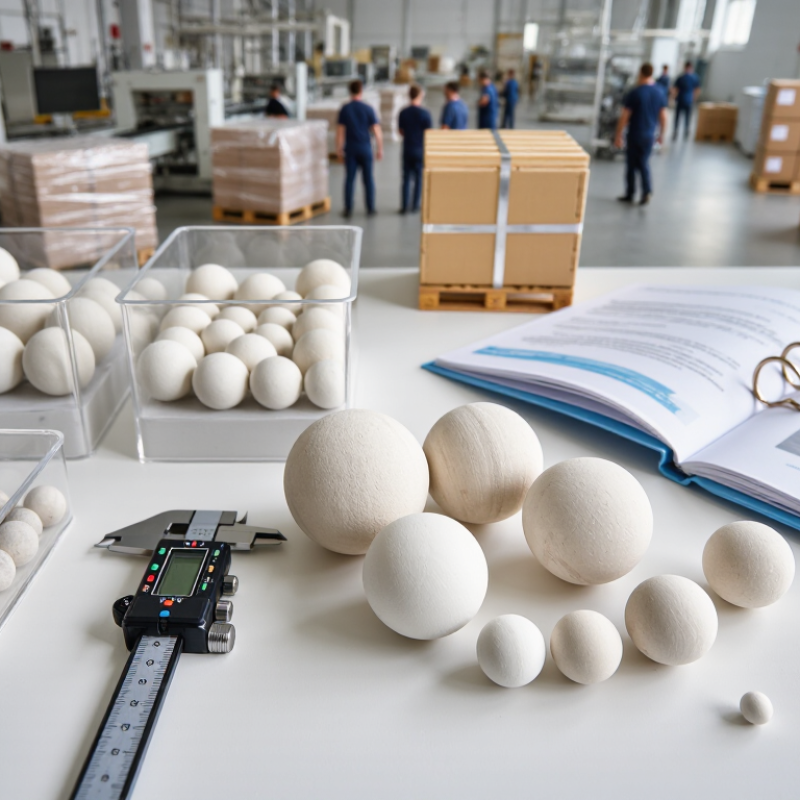
2026 Best Ceramic Ball Filler Suppliers for Global Buyers?

What Are Ceramic Ball Fillers and How Are They Used?

Ceramic ball fillers are shaped media made from fired mineral materials, often alumina, silica, or blended ceramics. They are usually inert, hard, and resistant to heat, pressure, and chemical exposure. In industrial equipment, they fill empty space inside packed beds, towers, and reactors. Their main role is not always chemical reaction. Many simply support catalysts, spread liquid flow, and protect equipment from sudden temperature changes.

In a reactor, larger ceramic balls may sit beneath the catalyst layer. They help distribute gas and liquid more evenly across the vessel. This can reduce channeling and local hot spots.

In absorption or drying towers, smaller ceramic pieces can increase contact between phases. Dense balls provide mechanical support, while porous grades offer more surface area. The difference matters. Choosing a porous product for a high-pressure support layer may create avoidable breakage.

From practical purchasing experience, global buyers should check crush strength, thermal shock resistance, water absorption, size tolerance, and chemical compatibility. A supplier should provide batch test data and clear traceability. Requesting samples is wise. Product drawings can hide real variation. I would not select fillers by price alone. A cheaper batch may create dust, pressure loss, or uneven flow during operation. Installation also needs care; dropping bags directly into a vessel can damage both balls and internal components. Ceramic fillers are durable, but they are not indestructible.

Key Types and Performance Grades of Ceramic Ball Fillers

Ceramic ball fillers vary by chemistry, density, porosity, and operating temperature. Alumina balls suit high-wear environments and demanding thermal conditions. Zirconia grades offer high toughness, but they usually cost more. Silica and mullite fillers can provide lower density and useful thermal stability. Cordierite is often selected where thermal shock matters more than extreme hardness.

Performance grades should match the actual process, not only the product name. Standard grades may support general packing and filtration duties. High-alumina grades resist abrasion, chemical exposure, and repeated heating cycles. Wear-resistant grades are useful in grinding or high-flow systems. Precision grades provide tighter diameter tolerances, smoother surfaces, and more consistent bed packing. Porous grades increase surface area, although their strength can decrease. A small trade-off.

Experienced buyers should request test data, not broad claims. Check alumina content, bulk density, water absorption, crushing strength, and dimensional tolerance. Ask for batch-based inspection records and samples from current production. A practical trial should measure pressure drop, attrition, breakage, and temperature change over time. Supplier reliability also depends on packaging, moisture control, traceability, and export documentation.

One point deserves reflection: the highest grade is not always the best choice. Excessive density can increase equipment loading. Very low porosity may reduce useful contact area. Results can change with fluid velocity, bed depth, and cleaning cycles. Independent laboratory verification remains sensible for critical applications.

2026 Best Ceramic Ball Filler Suppliers for Global Buyers? - Key Types and Performance Grades of Ceramic Ball Fillers

Technical comparison matrix for screening material types, performance grades, and purchasing specifications.

Ceramic ball filler type Typical chemistry Typical density
(g/cm³)
Mohs hardness Typical size range Key performance grade Typical operating temperature Best-fit applications Main purchasing checks
High-purity alumina balls Aluminium oxide, typically 92–99.9% Al₂O₃ 3.60–3.95 8–9 0.1–50 mm Wear-resistant / low contamination Up to approximately 1,500–1,700°C, depending on grade and atmosphere Abrasion-resistant coatings, polymer compounds, grinding media, high-temperature systems Al₂O₃ content, water absorption, bulk density, abrasion loss, roundness, trace metals
Zirconia toughened alumina balls Alumina matrix with approximately 10–30% zirconia 3.80–4.20 8–9 0.2–30 mm Balanced toughness and wear resistance Up to approximately 1,400–1,600°C, depending on formulation Technical ceramics, impact-resistant compounds, milling and dispersion processes Zirconia percentage, fracture toughness, abrasion rate, thermal-shock behavior
Stabilized zirconia balls ZrO₂ stabilized with yttria, magnesia, or ceria 5.70–6.20 8–9 0.1–30 mm Maximum wear resistance and toughness Usually selected for service below approximately 1,000–1,200°C in demanding wear applications Fine grinding, high-shear dispersion, electronic and pharmaceutical processing Stabilizer type, phase composition, fracture toughness, particle contamination, density uniformity
Fused silica balls Amorphous silicon dioxide, typically above 99% SiO₂ 2.15–2.25 5.5–6.5 0.5–50 mm Low thermal expansion / thermal-shock resistance Suitable for high-temperature service; exact limit depends on geometry, atmosphere, and binder Thermal-stable composites, electrical insulation, refractory and investment-casting systems SiO₂ purity, hydroxyl content, thermal expansion, softening behavior, moisture
Silicon carbide balls Silicon carbide, typically 97–99% SiC for technical grades 3.10–3.25 9–9.5 0.5–25 mm Extreme hardness and thermal conductivity Can operate at very high temperatures in suitable inert or reducing atmospheres Heat-transfer composites, refractory systems, wear liners, high-temperature filtration Free silicon, oxidation resistance, thermal conductivity, porosity, particle integrity
Hollow aluminosilicate ceramic microspheres Aluminosilicate glass-ceramic composition 0.60–0.80 apparent density 5–7 10–500 μm Lightweight / volume-building Often used from ambient temperature to approximately 1,000°C, subject to shell strength and binder Lightweight coatings, syntactic composites, thermal insulation, buoyancy materials Crush strength, particle-size distribution, true density, oil absorption, hollow-particle content
Mullite ceramic balls Aluminosilicate phase, commonly 3Al₂O₃·2SiO₂-based 2.60–3.10 6.5–7.5 1–50 mm Thermal stability and moderate density Typically selected for service up to approximately 1,400–1,600°C Kiln furniture, refractory packing, thermal-process media, high-temperature fillers Phase content, apparent porosity, compressive strength, thermal-shock resistance
Cordierite ceramic balls Magnesium aluminosilicate, 2MgO·2Al₂O₃·5SiO₂-based 2.40–2.70 6.5–7 1–50 mm Very low thermal expansion Commonly used for repeated heating and cooling cycles below approximately 1,200–1,300°C Thermal-shock applications, kiln supports, catalyst and process-media carriers Thermal-expansion coefficient, open porosity, water absorption, dimensional stability

Global buyer qualification checklist

Request a current technical data sheet and certificate of analysis for every production lot.
Verify particle-size distribution by laser diffraction or sieve analysis, as applicable.
Compare apparent density, true density, porosity, water absorption, and oil absorption separately.
Confirm surface treatment, moisture level, packaging, pallet configuration, and export documentation.
Use application-specific testing for abrasion, thermal shock, dielectric behavior, or compressive strength.

Note: Values shown are typical technical ranges for material screening and may vary with composition, forming method, porosity, firing schedule, and test method. Final specifications should be confirmed against the supplier’s lot-specific documentation and the buyer’s application requirements.

How to Evaluate Global Ceramic Ball Filler Suppliers

Selecting the best ceramic ball filler supplier requires more than comparing online prices. A polished website proves little. Request recent technical data, production photos, and a representative sample before making decisions. The sample should match the promised size, shape, density, porosity, and crush strength. Small differences can affect pressure drop, heat transfer, and operating life.

Reliable suppliers explain how they control raw materials and firing temperatures. Ask for batch traceability, inspection records, and a clear certificate of analysis. Independent testing can confirm chemical composition and mechanical performance. Certifications also deserve verification through issuing bodies, not copied logos. A supplier that avoids technical questions may create expensive delays later. Communication quality matters.

Global purchasing adds practical risks. Check packaging against vibration, moisture, and repeated port handling. Confirm production capacity, minimum order quantities, lead times, export documents, and delivery terms in writing. Calculate total landed cost, including freight, duties, testing, and possible rejected batches. Technical support should cover loading methods, replacement planning, and problem investigation. I have learned this the hard way: the cheapest quotation can become the costliest choice. No supplier is perfect, and even a strong audit has limits. Keep a written comparison, retain samples, and review performance after each shipment. That evidence improves the next decision.

Quality Standards, Testing Methods, and Technical Certifications

For 2026, global buyers should assess ceramic ball filler suppliers through measurable quality standards, not attractive product claims. A reliable supplier should provide particle-size distribution, chemical composition, moisture content, bulk density, oil absorption, whiteness, and thermal stability data. These values directly affect dispersion, viscosity, abrasion resistance, and final surface appearance.

Testing should combine supplier data with independent verification. Laser diffraction can confirm particle-size distribution, while X-ray fluorescence helps verify elemental composition. Moisture should be checked through controlled oven drying or an equivalent validated method. Buyers should also request batch samples and compare them under identical mixing conditions. Numbers need context. A low moisture result means little if testing conditions remain unclear.

Technical certifications add confidence when properly reviewed. ISO 9001 indicates a controlled quality-management system, while ISO/IEC 17025 accreditation supports laboratory competence. Certificates of analysis should include batch numbers, test dates, methods, and acceptance limits. Traceability from raw material to shipment is equally important. Document every batch. However, certification does not guarantee perfect filler performance in every formulation. I have seen acceptable laboratory results change after scale-up, especially when storage humidity and mixing energy were overlooked. Suppliers should therefore support application trials, retain samples, corrective-action records, and clear technical communication. A careful buyer may discover that one missing test method matters more than a long certificate list.

2026 Best Ceramic Ball Filler Suppliers for Global Buyers

Quality Standards, Testing Methods, and Technical Certifications

The chart compares representative density and Mohs hardness benchmarks for common ceramic filler ball material families. These properties are commonly verified through bulk-density, apparent-density, porosity, water-absorption, particle-size, and hardness testing before global procurement.

Reference framework: ASTM C20 and ISO 18754 for density, apparent porosity, and water absorption; ISO 9001 for quality-management systems; ISO 14001 for environmental-management systems; and ISO/IEC 17025 for competent testing laboratories. Certification validity depends on the certified scope and should be verified from the supplier’s current documentation.

International Purchasing, Pricing Factors, and Supplier Comparison

2026 Best Ceramic Ball Filler Suppliers for Global Buyers?

International purchasing starts with technical clarity, not a low quotation. Ceramic ball filler may serve as support media, tower packing, or protective bed material. Buyers should confirm diameter, alumina content, water absorption, crushing strength, bulk density, and operating temperature. Ask for recent test reports and production samples. A photo alone proves very little.

Pricing depends on raw material grade, ball size, tolerance, order volume, packaging, and destination freight. A supplier offering a lower unit price may use thinner cartons or weaker pallets. That creates breakage during ocean transport. Request prices under the same Incoterm, currency, quantity, and delivery point. Compare the full landed cost, including inspection, insurance, customs charges, and local handling. Small details matter.

Supplier comparison should include response quality, batch consistency, lead time, export experience, and after-sales handling. Reliable producers explain their inspection process and provide clear packing details, such as moisture protection and pallet weight. For a trial order, check size distribution and surface defects after delivery. Do not rely only on certificates; verify whether they match the actual batch. A rushed decision can save money today and create replacement costs later. Even experienced buyers sometimes overlook unloading damage or mismatched specifications. That deserves review.

Go to Top