Essential Tips for Choosing an EV Charger for Your Car?
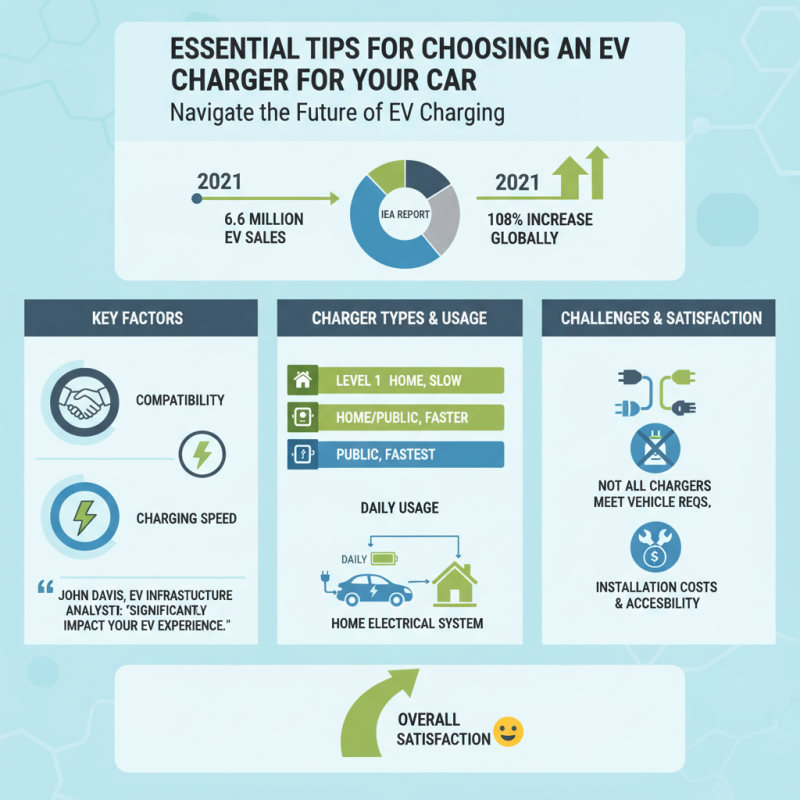
As electric vehicles (EVs) gain popularity, understanding how to choose the right EV charger is essential. According to a recent report by the International Energy Agency, global electric car sales exceeded 6.6 million units in 2021, a 108% increase from the previous year. This rapid growth highlights the need for adequate charging infrastructure, making the choice of an EV charger crucial for owners.
Experts suggest that compatibility and charging speed are vital factors. John Davis, an EV infrastructure analyst, emphasizes that "choosing the right charger can significantly impact your EV experience." Depending on your driving habits, the right Ev Charger Car can enhance convenience and reduce downtime. With various charger types available, from Level 1 to Level 3, it's important to assess your home's electrical system and daily usage.
While many embrace EV technology, challenges remain. Not all chargers are created equal, and some may not meet specific vehicle requirements. Additionally, accessibility and installation costs can vary widely. Evaluating these factors can make the difference in your overall satisfaction with your EV journey.
Understanding Different Types of EV Chargers: Level 1, Level 2, and DC Fast Chargers
When choosing an EV charger, understanding the types is crucial. Level 1 chargers are the most basic. They use a standard household outlet. Charging can take a long time, usually around 8 to 12 hours. This may not suit everyone’s needs.
Level 2 chargers provide more power. They require a dedicated circuit. Charging time can be reduced to 4 to 6 hours. They’re ideal for home use. However, installation costs can be significant. It’s essential to weigh these factors carefully. Some may misjudge their daily driving needs and end up with an inadequate charger.
DC Fast chargers are the quickest option available. They can charge an EV to about 80% in 30 minutes. These chargers are mainly found at public stations. The downside is that they are often more expensive to use. Critical decisions must be made. It’s important to analyze your commuting habits and charging requirements before settling on a specific type. Making the right choice can prevent future frustrations.
Key Factors to Consider When Choosing an EV Charger for Your Vehicle
When selecting an EV charger, several key factors demand attention. Charging speed is crucial. Level 2 chargers typically deliver 10-60 miles of range per hour of charging. This can significantly impact daily convenience. Consider your driving habits. If your daily commute is 30 miles, a Level 2 charger can replenish your battery overnight.
Compatibility is another important aspect. Not all chargers work with every vehicle. It's fundamental to verify that your chosen charger matches your car's requirements. A report by the International Energy Agency highlights that compatibility challenges can lead to frustration for 20% of EV owners.
Installation location plays a vital role too. Indoor vs. outdoor installation can influence the type of charger needed. Outdoor chargers should be weather-resistant and durable. Evaluating your home’s electrical capacity is necessary as well. You don't want to face unexpected costs later. Each installation scenario is unique, and sometimes adjustments are necessary. Balancing speed, compatibility, and installation requirements can be tricky. Taking time to consider these factors will lead to a more satisfying charging experience.
Essential Tips for Choosing an EV Charger for Your Car
| Factor | Description | Importance Level | Suggested Charger Type |
| Charging Speed | Determines how quickly you can recharge your vehicle's battery. | High | Level 2 Charger |
| Connector Type | Ensures compatibility with your EV's charging port. | Medium | Type 1 or Type 2 Connector |
| Installation Location | Space available for the charger installation, indoors or outdoors. | High | Hardwired or Plug-In Option |
| Smart Features | Allows remote monitoring and scheduling of charging sessions. | Low | Smart Charger with App |
| Price | Overall cost of the charger and potential installation fees. | Medium | Budget-friendly or Premium Models |
Charging Speed: How to Analyze Charging Rates and Vehicle Compatibility
When choosing an EV charger, focusing on charging speed is crucial. Different chargers provide varying charging rates. It’s important to analyze how these rates match your vehicle's capacity. Each electric vehicle has a maximum charging rate, which affects how quickly it can refill its battery.
Consider the types of chargers available. Level 1 chargers are the slowest, typically using a standard household outlet. Level 2 chargers work much faster, often found in public charging stations. DC fast chargers offer the quickest charge. However, not all vehicles are compatible with DC charging. Check your vehicle’s specifications.
Tips to remember: Always match the charger’s output with your car's limits. An overpowered charger won't necessarily charge faster. It might even harm the battery over time. Think about your daily driving routine. Do you need a quick charge for long trips? Or can you charge overnight? Evaluating your needs will help you make a better decision. Keep an eye on the charger’s installation requirements too. It can add to the overall cost.
Assessing Installation Requirements and Costs for Home EV Charging Stations
Installing a home EV charger involves critical factors. One key aspect is electrical capacity. Most homes may require an upgrade to support the charger. Research indicates nearly 30% of homes lack adequate electrical infrastructure. This could lead to additional costs. Upgrading your electrical panel can add $1,000 to $3,000 to your overall installation cost.
Another consideration is the location of the charger. Installing it in the garage often requires less complex wiring than outdoor installations. However, outdoor installations might add extra expenses for weatherproofing and surface mounting. Ensuring proximity to your vehicle also impacts installation time and labor fees, which average between $500 and $1,500.
Lastly, evaluating your charging needs is vital. Level 2 chargers typically provide faster charging but may require a 240-volt outlet. These chargers can fully recharge an EV in 4 to 8 hours, depending on the model. Yet, not all homes can support this type. Assessing your energy requirements beforehand can prevent costly surprises. Understanding these installation requirements is essential before making a decision.
Evaluating Smart Charger Features and Their Impact on EV Management
When selecting an EV charger, smart features play a crucial role. According to a report from the International Energy Agency, smart chargers can optimize energy usage and reduce costs. For instance, these chargers can schedule charging during off-peak hours, often leading to savings of up to 20% on electricity bills. This means not only convenience but tangible financial benefits.
Monitoring capabilities are essential. Many smart chargers offer real-time data tracking, helping users manage their charging habits better. Studies indicate that 35% of EV owners underutilize their charging capabilities. With smart technology, users can receive alerts and insights on their charging patterns, prompting action where needed. This pushes for better efficiency and promotes sustainability.
However, not all smart features guarantee easy use. Some users report a steep learning curve when navigating through advanced settings. This can lead to frustration, especially for those less tech-savvy. It's vital to weigh the benefits of smart functionality against potential complexities. In an industry that's rapidly evolving, the challenge remains—finding the right balance between simplicity and advanced features.